Your next customer may already be searching for the service your business provides. They might need a software development partner, a website redesign or a local service provider. The opportunity lies in appearing when that search reflects a genuine need—and giving the person a clear reason to contact you.
Google Ads can help businesses reach these potential customers through paid advertising. However, generating clicks is different from generating qualified leads. A campaign can attract visitors while producing enquiries that have little chance of becoming customers.
At Hitech Innovative Solutions, we approach PPC lead generation as a complete customer journey. Audience intent, advertising, landing pages, measurement and sales follow-up must work together to turn advertising investment into meaningful business opportunities.
Google Ads is an advertising platform that enables businesses to promote their products and services across Google’s advertising channels. This article focuses primarily on Search campaigns, where businesses can reach people searching for relevant solutions.
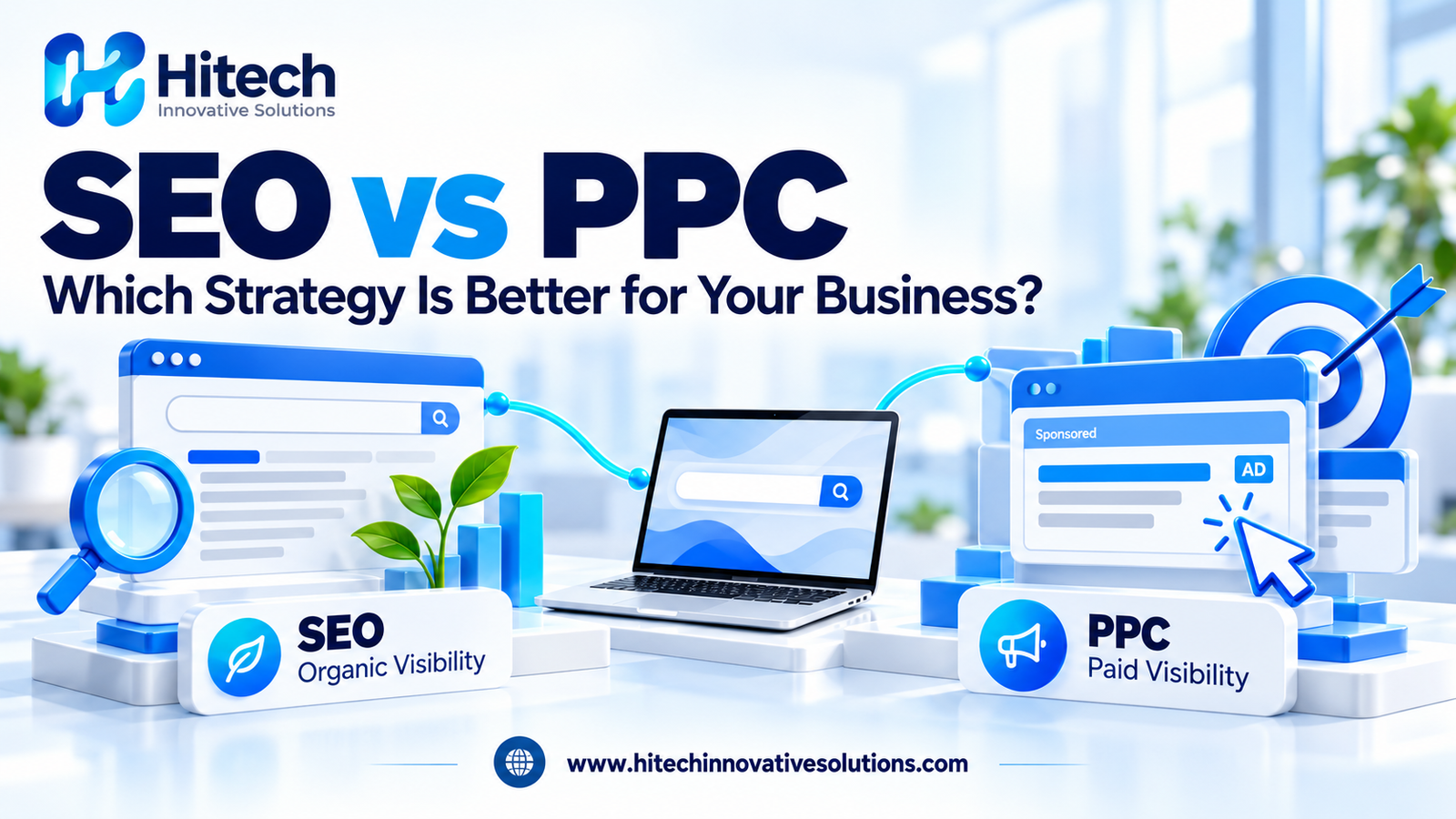
PPC stands for pay-per-click. Under this advertising model, a business pays when someone clicks its advertisement. The cost varies according to factors such as competition, the search context and the campaign’s bidding approach.
Successful PPC management requires more than selecting keywords and setting a budget. Businesses need relevant advertisements, useful landing pages and a reliable way to evaluate what happens after the click.
A search reveals something about what a potential customer needs. Someone searching “what is custom software” may be researching a topic. Someone searching “custom software development company for inventory management” may be evaluating providers.
Both searches relate to software, but they suggest different stages of the buying journey.
For lead generation, businesses should identify searches that align with their services and commercial priorities. A specialised company may benefit more from a smaller audience seeking its exact solution than from broad visibility across loosely related searches.
Understanding intent helps shape the campaign’s message and the page visitors see next.
A qualified lead is an enquiry that meets the business’s agreed criteria for a potential customer. Those criteria might include service requirements, location, project scope, budget or purchasing timeline.
For example, a website development enquiry may be relevant only if the person needs a service the company actually provides. A student requesting training and a business seeking an e-commerce website represent different opportunities.
Marketing and sales teams should agree on these distinctions before advertising begins.
Google Ads supports qualified-lead and converted-lead measurement, allowing businesses to distinguish initial enquiries from later outcomes in the sales process.
Keyword research should connect customer language with the services your business wants to sell.
A company offering mobile application development should consider how prospective customers describe their projects. Searches may reference an application type, industry, business problem or development requirement.
Campaign structure should preserve these differences where they affect the message. Someone seeking an online store needs different information from someone looking for enterprise software development.
Google’s setup guidance recommends choosing keywords around what customers search for and directing visitors to relevant landing pages.
The objective is a clear connection between the search, the advertisement and the service offered.
Keyword targeting also requires deciding which searches should not trigger advertisements.
Depending on the business, searches involving jobs, tutorials or unrelated services may bring visitors who are unlikely to become customers. Negative keywords can help exclude unsuitable searches.
However, exclusions should be applied carefully. A word that appears irrelevant in one context may be useful in another. For example, “free” could be unsuitable for a paid service campaign but relevant when promoting an available consultation.
Google’s guidance explains that negative keywords help prevent ads from appearing for specified searches, with behaviour depending on the negative match type.
An effective advertisement should help people decide whether the business fits their needs.
Clear service descriptions, relevant benefits and an appropriate next step are more useful than vague promises. A software company might highlight custom development, business-system integration or support for a particular application.
Where appropriate, the message can also establish expectations about the service scope or customer type.
Businesses should avoid unsupported claims and offers they cannot fulfil. An advertisement that attracts attention through unrealistic promises may generate clicks while creating poor-quality enquiries.
The aim is to bring suitable prospects to the next stage with accurate expectations.
A landing page should continue the conversation started by the advertisement.
If someone clicks an ad about e-commerce development, the page should explain that service promptly. Sending them to a general homepage may require unnecessary searching before they find relevant information.
The page should clarify what the business offers, who the service suits and how to make an enquiry. Relevant work examples, a straightforward process and genuine customer feedback can support the decision.
Forms should request information that helps the next conversation. Asking about the service required or project scope may be useful, provided the form remains manageable on mobile devices.
Conversion tracking should reflect meaningful actions.
A contact-button click does not necessarily mean someone completed an enquiry. Similarly, a submitted form does not establish that the person is a suitable customer.
Businesses should verify successful form submissions and connect enquiries with their later sales outcomes where possible. Duplicate events, internal tests and spam can otherwise distort reporting.
Google provides offline conversion measurement options that help connect online advertising interactions with subsequent business outcomes. Enhanced conversions for leads can support this process using appropriately collected first-party information.
Implementation should respect applicable consent requirements and Google’s policies.
A useful advertising budget reflects what the business can afford to spend to acquire customers.
Consider a hypothetical campaign spending ₹30,000 and generating 30 enquiries. Its cost per enquiry is ₹1,000. If only six meet the qualification criteria, the cost per qualified lead is ₹5,000.
Whether that result is commercially acceptable depends on how many qualified leads become customers and the value those customers create.
Businesses should therefore assess more than the cheapest enquiry. Campaign evaluation should consider qualification rate, customer acquisition cost and the contribution of resulting sales.
These relationships provide a stronger foundation for budget decisions than traffic volume alone.
Campaign settings should support the outcomes the business wants to achieve.
If the account treats every minor interaction as equally valuable, performance reporting may become disconnected from commercial success. Measurement should distinguish useful engagement from the outcomes that matter most.
Automated bidding also requires thoughtful configuration and monitoring. It does not remove the need to review traffic relevance, lead quality and tracking accuracy.
Businesses should allow for their sales cycle when evaluating results. A campaign generating longer-term opportunities cannot be judged entirely through enquiries received yesterday.
Changes should follow evidence rather than frequent reactions to small fluctuations.
Advertising creates an opportunity for conversation. The business still needs a practical process for handling that opportunity.
Enquiries should reach the right person with enough information to respond appropriately. Clear ownership prevents leads from sitting unattended or receiving conflicting replies.
Sales feedback also helps improve campaigns. If unsuitable enquiries repeatedly share the same requirement, the advertising message or targeting may need adjustment.
Useful lead-generation reporting combines marketing information with what the sales team learns. This creates a feedback loop in which campaign decisions become more closely connected to actual customer needs.
At Hitech Innovative Solutions, we help businesses connect digital marketing with their wider growth objectives. Our approach considers the relationship between campaign strategy, website experience, conversion measurement and business follow-up.
Our capabilities across web development, custom software and digital marketing help us assess the journey beyond the advertisement. A campaign may need a more relevant landing page, a clearer enquiry process or better visibility into lead outcomes.
We focus on identifying these priorities and developing solutions around the business’s services, audience and available resources.
Google Ads can help businesses reach people actively exploring relevant solutions. Generating qualified leads requires a clear offer, appropriate targeting and a dependable process after the click.
For businesses planning to launch or improve PPC campaigns, Hitech Innovative Solutions can help develop an approach aligned with measurable commercial goals.