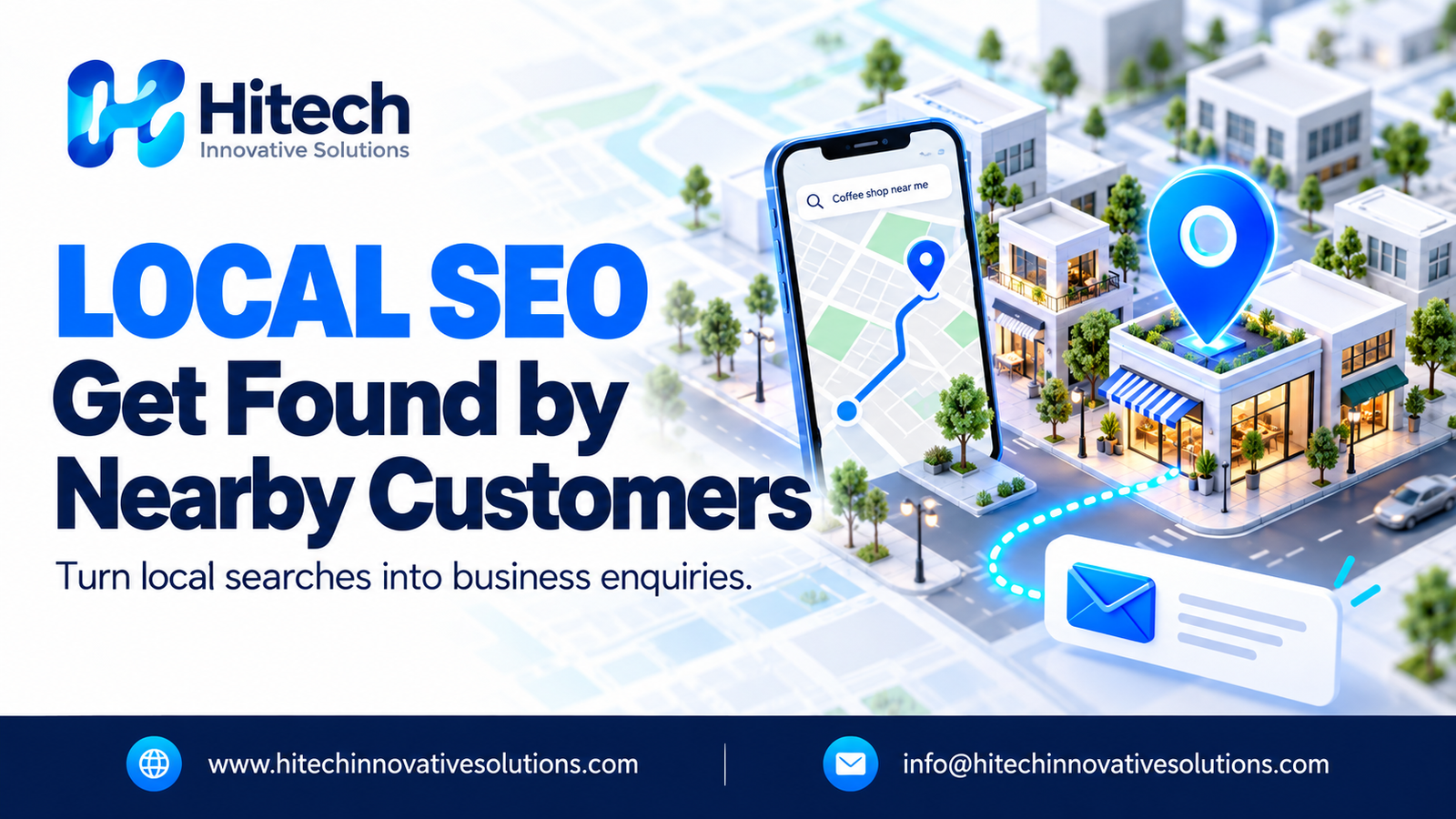
When someone searches for a nearby service, they usually have a practical need. They might want a quotation, directions, an appointment or a company they can speak with today. Appearing in that search creates an opportunity to turn local demand into a business conversation.
However, having a website does not automatically make your business easy to find. Customers need accurate information, relevant service details and clear reasons to contact you.
Local SEO connects these elements. At Hitech Innovative Solutions, we approach local search visibility as part of a wider business objective: helping suitable customers discover your services and take the next step with confidence.
Local search engine optimization improves how a business presents itself to people searching within a relevant geographical area. It involves your website, Google Business Profile, customer reviews and other public business information.
A search such as “website development company in Noida” includes an explicit location. A search such as “repair service near me” relies more directly on the searcher’s location.
Both reflect a need for a provider serving a particular area. A local SEO strategy should therefore connect your services with the places where your business genuinely operates.
Local visibility can introduce your business to customers at different stages of their decision. Some are comparing providers, while others are ready to book or call.
Consider a business owner looking for a website redesign partner. They may prefer a nearby team for meetings, project discussions or ongoing support. A relevant service page and clear contact information can help them evaluate that option.
The objective is to become discoverable where your capabilities match demand. More visibility outside your service area may increase traffic without producing useful enquiries.
Google explains that local results mainly consider relevance, distance and prominence. Relevance concerns how closely a business matches a search, distance concerns its location relative to the searcher, and prominence reflects how well known it is. Businesses cannot pay Google for a better organic local ranking.
This helps explain why results can vary between customers searching from different locations.
Your strategy should concentrate on accurate representation, relevant content and customer experience. Promising the same position across an entire city ignores factors your business cannot fully control.
For eligible businesses, Google Business Profile is an important place to present location and service information. Eligibility generally involves a customer-facing physical location or a business that travels to customers. An online-only business should check the applicable rules before creating a profile. Use your real business name, appropriate categories and accurate contact details. Explain what you offer clearly, without adding unrelated services or promotional keywords to the name.
Treat the profile as a customer information resource. Someone discovering you there should understand what your business does and how to contact the right team.
Conflicting information creates avoidable uncertainty. A customer may hesitate if your website shows one number while a business listing displays an outdated number or address.
Establish a reliable set of business details and review your main public profiles against it. Keep location names, telephone numbers and contact destinations clear.
Consistency does not require every abbreviation to look identical. The priority is that customers can identify the same business and reach the intended location.
When your business relocates or changes contact details, updating those public references should be part of the operational checklist.
Local keyword research should begin with the services customers actually seek. A broad phrase may attract attention, but a specific search can communicate a clearer requirement.
For example, “software company” covers many possibilities. “Inventory management software development in Noida” describes a particular business need and location.
Use customer conversations, enquiry records and search-performance data to investigate these themes. Keyword tools can provide additional context, but their estimates should not replace business judgement.
Choose phrases that match your offer, audience and service area. Avoid adding every nearby city simply because it might attract another search.
A strong service page helps visitors decide whether your business can meet their needs. It should explain the service, the process and the appropriate next step.
For a website development provider, useful information might include project discovery, design, content responsibilities, implementation and maintenance. Relevant examples can show how those activities come together.
Location references should fit naturally within that explanation. Repeating a city name throughout the page makes the content harder to read.
Give each important service a clear purpose, then connect it with related examples and a suitable enquiry option.
Businesses serving several areas may benefit from location pages when there is meaningful information to provide.
A useful page could explain the services available in that area, how appointments work and whether customers can visit a staffed office. Local project examples may also help, where publication is permitted.
Changing only the city name across otherwise identical pages contributes little to the customer’s decision.
Publish a location page when it answers genuine local questions. Do not imply that an office exists where you only provide remote services, or create business profiles for locations that do not meet Google’s requirements.
Reviews help potential customers understand experiences beyond your own marketing copy. They can offer context about communication, service delivery and how a business responds when something goes wrong.
Ask customers for honest feedback through a straightforward review link or QR code. Google prohibits incentives offered in exchange for posting, changing or removing reviews. Respond professionally and protect customer privacy. A complaint should receive a useful response, not a public argument.
Review themes can also inform improvements. Repeated questions about pricing or appointments may reveal information your website needs to explain more clearly.
Being found is only the beginning. Customers still need a practical route from discovery to enquiry.
Check your website on a mobile phone. Can someone read the service information, find the correct number and complete the form comfortably? Do the contact options work as expected?
Explain what happens after submission. A realistic response expectation can reduce uncertainty, provided your team can consistently meet it.
Forms should request information that helps the conversation. For a project enquiry, the service required and a short description may be more useful than a long list of mandatory fields.
Local content works best when it addresses questions that matter to your audience. An article for nearby manufacturers could explain how to prepare for a software implementation discussion. A service business might publish practical guidance about choosing a suitable provider.
Use experience and specific examples rather than inserting location names into generic articles.
Relevant relationships can support discovery too. Genuine collaborations, local business associations and community activities may introduce your company to suitable customers.
Evaluate these opportunities by audience fit and business value. A directory listing that sends irrelevant traffic is less useful than a credible referral from a relevant organisation.
Local SEO reporting should explain whether visibility is producing useful opportunities.
Website visits and search impressions provide context, but they do not establish lead quality. Track accepted enquiries, calls that become conversations, appointments and customers where reliable measurement is available.
Ask your team to record service requirements, customer location and the outcome of each enquiry. This can reveal whether your marketing reaches people you can serve.
Compare equivalent periods and recognise seasonal changes. A temporary increase in searches does not necessarily prove that one website adjustment caused business growth.
Hitech Innovative Solutions provides search engine optimisation, digital marketing and website development services. These capabilities create an opportunity to connect search visibility with the website experience customers encounter after clicking.
A practical local SEO programme begins by understanding your services, operating areas and enquiry process. Those findings guide business-profile improvements, keyword selection, service content and website changes.
Ongoing review then helps identify what attracts suitable customers and what needs refinement. The approach should reflect your business rather than apply the same location keywords and content plan to every company.
Local SEO requires accurate information, useful service content and a reliable customer journey. Together, these help nearby customers discover your business, evaluate its suitability and make contact.
Start with the areas you can serve well. Explain your offer clearly, maintain your public information and measure the quality of the opportunities you receive.
If your business needs stronger local visibility and a clearer path to enquiries, discuss your goals with Hitech Innovative Solutions.
Visit www.hitechinnovativesolutions.com or email info@hitechinnovativesolutions.com to start the conversation.
Local SEO improves how a business appears to customers searching for services in a particular area. It includes website optimisation, accurate business listings, Google Business Profile management and customer reviews.
Local SEO helps customers discover your services when they search nearby. Clear service information, genuine reviews and accessible contact options can encourage relevant calls, appointments and enquiries.
Eligible businesses generally have a physical location customers can visit or travel to customers to provide services. Online-only businesses should check Google’s eligibility requirements before creating a profile.
There is no fixed timeline. Results depend on competition, location, the website’s condition and existing visibility. Some improvements may appear within weeks, while broader progress can require several months of consistent work.
Genuine reviews help customers evaluate a business and can contribute to local prominence. Ask for honest feedback, respond professionally and avoid offering incentives for reviews.
Create location pages when each provides useful, distinct information about an area you genuinely serve. Avoid duplicating the same content with different city names.
Hitech Innovative Solutions can support local keyword research, service-page optimisation, business-profile improvements and website development, with a focus on attracting relevant enquiries.