A website should do more than introduce your business. It should help potential customers discover your services, understand your expertise and take the next step towards working with you. However, even a well-designed website can struggle to generate enquiries when it does not reach the right audience.
Search engine optimisation connects your business with people actively looking for relevant products, services and answers. A focused SEO strategy can support a continuing flow of opportunities by improving how customers find and experience your website.
At Hitech Innovative Solutions, we see SEO lead generation as a connection between visibility, useful content and business outcomes. The objective is to attract visitors whose needs match your services and give them a clear reason to enquire.
SEO lead generation involves attracting potential customers through organic search and helping them become business enquiries. A lead might be someone requesting a quotation, booking a consultation, calling your team or submitting a project brief.
For example, someone searching for “custom software development company” has a different need from someone researching “what is custom software”. Both searches can matter, but they require different content and next steps.
An effective strategy connects these needs with suitable pages. Educational articles support research, service pages explain your offer, and project examples help potential customers evaluate your capabilities.
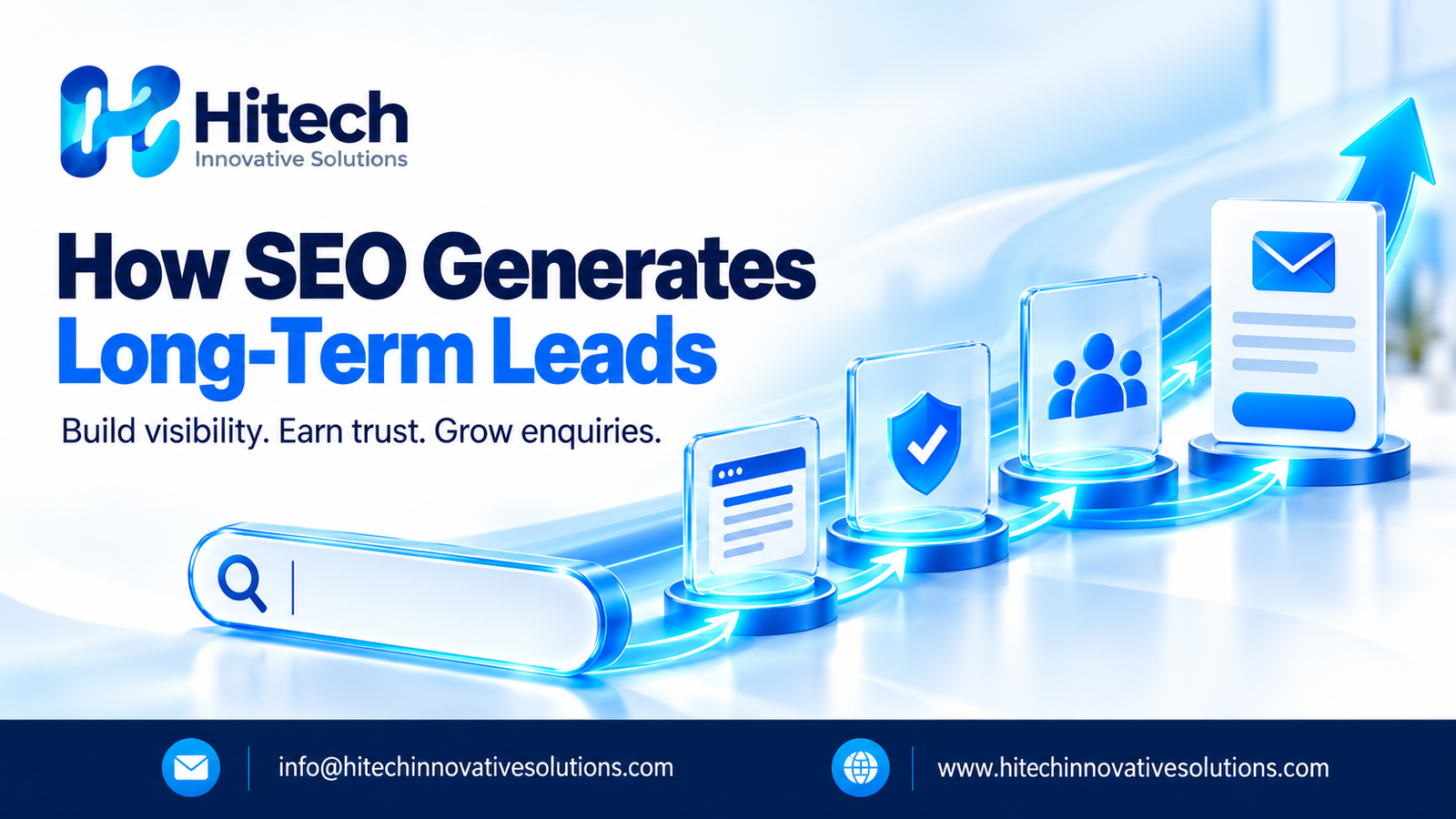
SEO improvements can remain useful beyond the day they are published. A relevant service page or detailed buying guide may continue attracting potential customers while its information stays accurate and competitive.
This creates an opportunity to develop a stronger website over time. Each useful page can answer another customer question, explain a service more clearly or support an existing page through internal links.
However, organic visibility requires ongoing work. Competitors change, customer expectations develop and content becomes outdated. Sustainable SEO services therefore involve reviewing performance and improving the website continuously. No strategy can guarantee first-page rankings or a fixed number of leads.
Effective keyword research starts with your customers’ problems and buying decisions. Search volume is useful context, but a popular phrase is not automatically valuable to your business.
A software development provider might investigate searches around custom business software, CRM development and workflow automation. A website development company might focus on business websites, e-commerce development and website redesign services.
More specific phrases can reveal clearer requirements. Someone searching for “custom inventory management software for manufacturers” communicates a particular business problem. Where that service is genuinely offered, a relevant page can explain the solution, implementation considerations and enquiry process.
The goal is to match keywords with real capabilities rather than attract every possible visitor.
On-page SEO brings clarity to individual website pages. Titles, headings, descriptions and page content should explain the main service in language customers recognise.
A website redesign page, for example, should address common reasons for replacing an existing website. It can explain the discovery process, content migration, mobile experience and ongoing maintenance instead of relying on broad statements about digital transformation.
Each page needs a clear purpose. Supporting terms should appear naturally where they help explain that purpose. Internal links can then guide visitors towards related services, project examples and useful articles.
This approach helps potential customers understand both what you offer and whether it fits their requirements.
Technical SEO addresses how search engines access and interpret a website. Important pages should be discoverable, suitable for indexing and supported by a consistent URL structure.
An SEO audit can identify issues such as unintended indexing restrictions, broken internal links, conflicting canonical signals and unnecessary redirects. Resolving these problems helps protect the visibility of valuable service content.
The visitor experience also matters. Mobile layouts, secure browsing, readable content and stable page elements deserve attention alongside loading performance. Google recommends considering the overall page experience rather than concentrating on one isolated score.
For businesses investing in web development, considering these requirements during implementation can reduce avoidable problems later.
Many customers need information before they are ready to contact a provider. Content marketing allows your business to answer those questions with useful explanations.
A company considering a mobile application may want to understand development stages, maintenance responsibilities and integration requirements. A business exploring cloud services may need guidance on migration planning and operational responsibilities.
Strong content addresses these concerns directly. Original examples, practical explanations and relevant experience make an article more useful than a page written mainly to repeat keywords.
Google’s guidance encourages content created to benefit people, with an emphasis on originality, reliability and meaningful value.
For lead generation, every article should also offer an appropriate next step when readers want further help.
Local SEO helps eligible businesses present accurate information to people searching within relevant locations. This can be particularly useful when customers prefer a nearby provider or require services within a defined area.
An accurate Google Business Profile, suitable categories, current contact details and genuine customer reviews support this work. Google explains that local results consider relevance, distance and prominence, so businesses cannot control every factor affecting visibility.
Location pages should reflect genuine service availability and contain useful local information. Repeating the same page across numerous city names offers little help to customers.
The commercial objective is straightforward: attract enquiries from locations your team can serve effectively.
Off-page SEO considers how your business is represented beyond its own website. Relevant industry coverage, legitimate business listings and links earned through useful resources can support discovery and credibility.
For example, a detailed implementation guide may attract attention from an industry publication. A genuine partnership may also create an opportunity for a relevant business mention or referral.
The emphasis should remain on relevance and editorial value. Purchasing links to manipulate rankings or distributing repetitive promotional comments can conflict with Google’s spam policies.
For long-term lead generation, useful relationships and credible recommendations are more meaningful than a large collection of unrelated links.
Organic traffic creates an opportunity; the website must help visitors act on it. Conversion rate optimisation examines whether the enquiry journey is clear, relevant and easy to complete.
Service pages should explain the offer, establish credibility and provide an appropriate call to action. A visitor exploring custom software may need a project discussion, while someone comparing website services may prefer to request a quotation.
Forms should collect enough information to support a useful response without becoming unnecessarily demanding. Relevant case studies and clear explanations of what happens next can also reduce uncertainty.
Testing should consider enquiry quality alongside submission volume. More form completions are valuable only when they represent suitable opportunities.
SEO reporting should connect search performance with business results. Search Console can support visibility analysis, while website analytics and CRM records help explain what happens after visitors arrive.
The important question is whether organic search produces suitable enquiries, attended consultations, proposals and customers. A business receiving fewer enquiries with a strong service fit may achieve better outcomes than one receiving large volumes of irrelevant requests.
Cost per qualified lead should account for content, technical work and ongoing optimisation. Revenue reporting should also recognise that customers may research over several visits before making contact.
This gives businesses a more useful view of SEO performance than rankings alone.
Hitech Innovative Solutions provides SEO and digital marketing alongside website development, software development, mobile applications and other technology services. This combination creates an opportunity to connect marketing requirements with the website experience supporting them.
For businesses seeking long-term leads, the work begins with understanding their audience, services and commercial priorities. Those decisions guide keyword selection, service-page improvements, content planning and the enquiry journey.
A growing company may need clearer positioning for an existing website. Another may require a redesign that makes its services easier to discover and evaluate. The right approach depends on the business and the evidence available.
Long-term SEO lead generation requires consistent attention to relevance, technical reliability, useful content and customer experience. These elements work together to help people discover your business and decide whether to contact you.
The strongest strategy gives every important page a practical role: answer a question, explain a service, demonstrate capability or support an enquiry.
If your website attracts visitors but struggles to generate relevant opportunities, Hitech Innovative Solutions can help you assess what needs to improve.